Chemistry, Compatibility, and Conscious Alignment: Understanding the Difference
Most people were taught to feel a relationship long before they were taught how to understand one.
We notice the spark. The pull. The unusually easy conversation that turns a one-hour coffee into three. Because chemistry arrives quickly and vividly, it can begin answering questions nobody actually asked it.
Is this person right for me? Can we build a relationship? Do we want the same future?
Chemistry can tell us that something is happening. It cannot answer every question about what that something means.
The REAL Attraction Pyramid™ brings three different dimensions of relationship potential into view: Chemistry, Compatibility, and Conscious Alignment. The Pyramid represents structure, not progression. These are not levels to climb, and no dimension is a prize.
The framework does not tell you whom to choose. It helps you understand what you are choosing.

Chemistry: What pulls us together?
Chemistry is the experience of attraction and activation that creates a sense of pull between two people.
It may include physical attraction, emotional charge, intellectual stimulation, playfulness, sexual desire, fascination, heightened attention, or simply the wish to be near someone again.
Chemistry matters. A romantic connection without enough attraction can feel like a very respectful committee meeting.
But chemistry has a particular job. It tells us that something is activated. It does not independently determine whether the relationship is healthy, whether two people can function together, or whether their lives can move forward in compatible directions.
Attraction is information. It is not instruction.
Compatibility: How do we function together?
Compatibility concerns the way two people's relational mechanics interact and how effectively they can function together in partnership.
This becomes visible in ordinary life: communication, emotional processing, decision-making, needs, affection, conflict, repair, pace, lifestyle, responsibility, and the thousand small agreements from which a relationship is actually made.
Two people may both value communication and still communicate very differently. One wants to talk while the feeling is warm. The other needs time to understand what they feel before speaking. The difference does not automatically make them incompatible. What matters is the relational effect. Can they create a way of handling the difference without either person chronically overriding something essential about themselves?
Similarity describes the individuals. Compatibility describes the interaction.
That is why a list of shared traits cannot settle the question. A similarity may create ease or friction. A difference may create complementarity or friction. Lived experience shows how the qualities meet.
Conscious Alignment: Where are we going together?
Conscious Alignment concerns whether two people's deeper life directions, growth trajectories, and orientations toward partnership can move forward together.
It asks about the relationship each person is actually willing and able to build. What does partnership mean to them? What kind of life are they creating? Can their priorities, responsibilities, values, and visions coexist in practice?
Alignment does not require identical goals or identical paths. It requires compatible direction, not matching biographies.
Two people can care deeply for one another and function well in the present while wanting futures that cannot both be lived inside the same partnership. One may want children and the other may not. One may be building a rooted community while the other wants a highly mobile life. Neither person has to be wrong for the direction to deserve serious attention.
Conscious Alignment describes trajectory, not destiny. Direction can become clearer or change as people and circumstances evolve.
Self-Alignment gives discernment somewhere to stand
The three relationship dimensions do not interpret themselves.
Before asking what a connection means, you need some understanding of the person asking the question. What matters to you? What do you genuinely require? Which patterns have shaped your choices? Does your current behaviour agree with the future you say you want?
This is the role of Self-Alignment. It provides the personal context required for discernment. It is not a fourth relationship dimension, and it is not something another person or tool can calculate for you.
The same connection may be appropriate for one person's life and misaligned with another's. Without Self-Alignment, it is easy to assess a relationship according to general desirability rather than the life you are actually building.
A compelling connection can contain different truths
Imagine two people who share immediate attraction and can talk late into the night. They are playful, curious, and genuinely excited to see one another. The Chemistry is strong.
As they spend more ordinary time together, they begin to notice differences. One makes plans carefully and keeps them. The other is spontaneous and often changes course at the last minute. Sometimes this creates delight. Sometimes it creates exhaustion. Their Compatibility is not answered by the difference itself. It is explored through what happens when they discuss it, make agreements, and try to function together.
Then a future conversation reveals that one wants to build a shared home and raise children, while the other does not want either. Their attraction remains real. Their affection may be real. Their differing direction is also real.
Different dimensions may deserve different weight. Strong Chemistry does not erase an essential mismatch in life direction.
Chemistry, Compatibility, and Conscious Alignment can each be strong, developing, or challenging. They can change as new lived evidence appears. A careful understanding holds the dimensions together without collapsing them into a single verdict.
Where reflective tools fit
Conversations, observed behaviour, and evolving context remain essential. A person's actions can show whether words are supported in practice. Conflict can reveal capacity for repair. Time can show whether a promising pattern is consistent.
Reflective frameworks can add another lens. In my work, Human Design is used as a reflective framework, not established science. LACE™ provides structured Human Design-based indicators related to Chemistry, Compatibility, and Conscious Alignment. Those indicators may prompt useful questions. They do not establish emotional readiness, safety, relationship structure, compatibility as lived, or future outcomes.
A tool can organize selected information. Human judgment still decides what that information means beside behaviour, needs, conversations, circumstances, and experience.
Potential describes what may be possible. Behaviour reveals what is actually being lived.
A concise reflection
Think of a connection you want to understand more clearly.
What is drawing you together?
What have you learned about how you function together in ordinary life?
What do you each appear to be building toward, and which parts of that direction have been discussed rather than assumed?
Finally, ask what your own requirements and patterns lead you to give the most weight right now.
You do not need to turn love into an inspection. You are allowed to enjoy the spark. The wisdom is in letting the spark be meaningful without asking it to impersonate the whole relationship.
Continue your learning
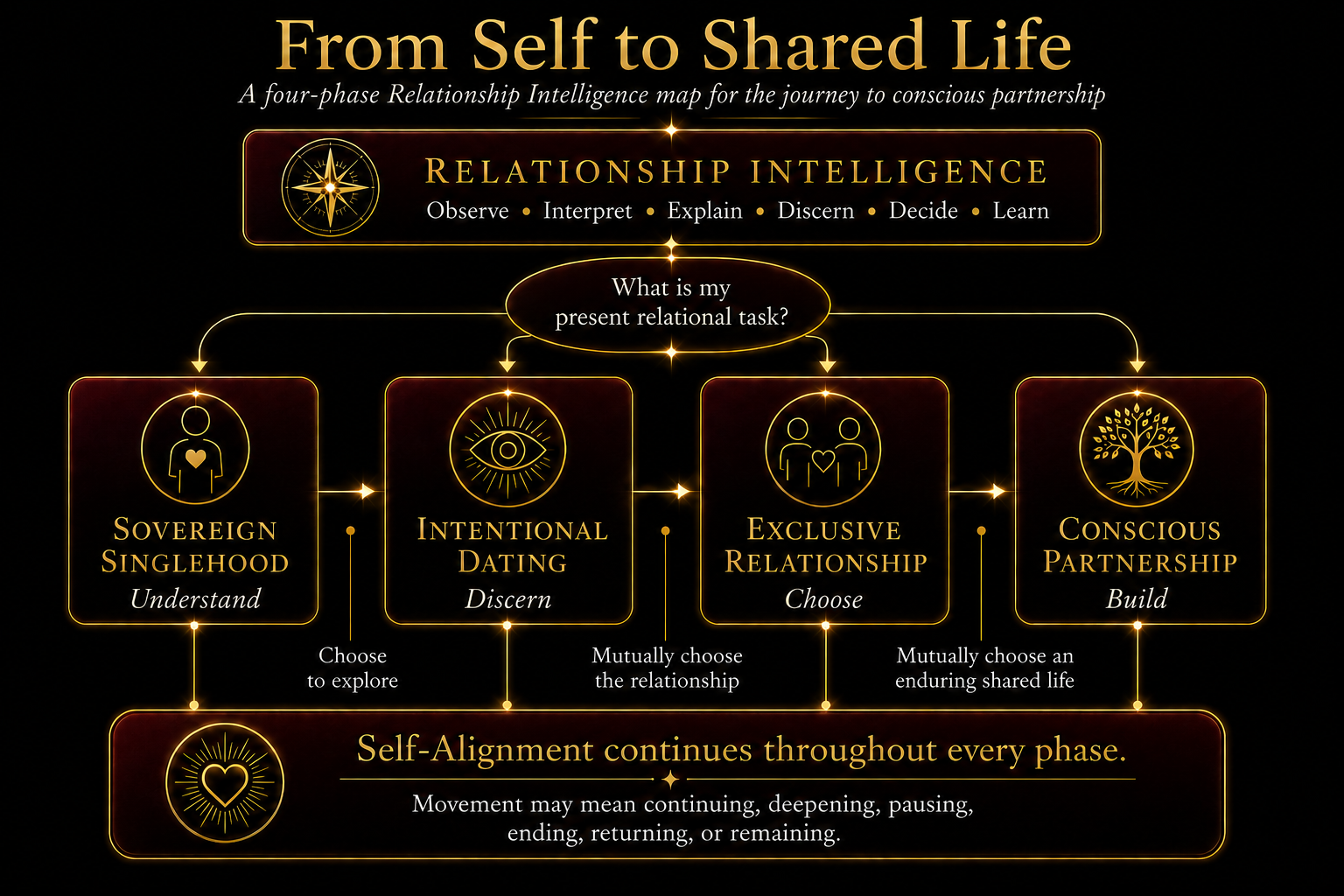
Explore Journey Learning to consider which relational task deserves attention now.
For the foundation behind this practice, read What Is Relationship Intelligence?.
